
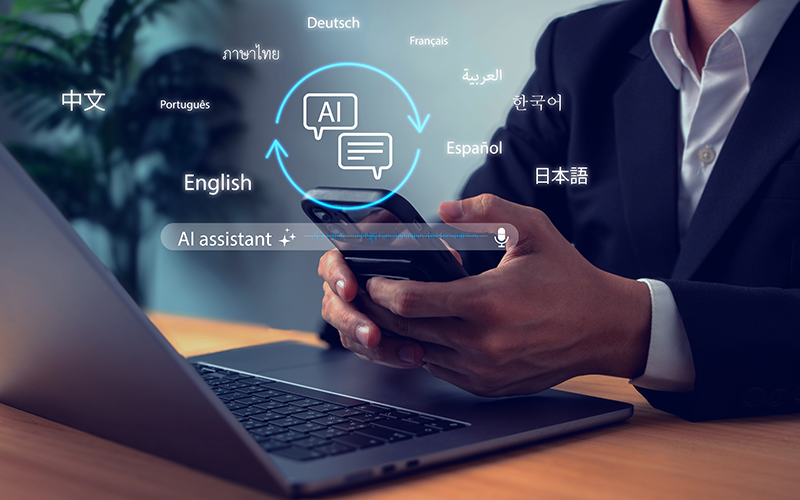
Expanding into new markets has never been easier, but producing trusted content for them is another matter. For ambitious B2B organisations, international expansion presents one of the biggest growth opportunities available. Whether you are a SaaS company entering Germany, a fintech expanding across Europe or a healthcare business launching in North America, success depends on far more than simply translating your website.
Customers expect content that feels local — accurate technical terminology, consistent brand voice, appropriate cultural references, regulatory awareness and natural language written by people who understand the market. Historically, producing this type of multilingual content has been expensive, slow and difficult to scale. Generative AI has changed that, but only up to a point. Our research shows that while AI dramatically accelerates content production, human expertise remains essential before content is ready for publication.
AI has transformed multilingual content production
Marketing teams are under increasing pressure to produce more content than ever before. Our survey found 84% adopted AI to increase content output, 79.6% adopted AI to accelerate delivery, 45.4% say output expectations have increased by more than 50%, and 63% report turnaround expectations are at least 50% faster.
For organisations operating internationally, these pressures multiply across every language they support. One campaign can quickly become ten blog articles, eight landing pages, email sequences, social campaigns, white papers and product documentation — across five or six languages. AI makes this scale possible, but scaling poor quality content simply creates bigger problems.
Translation is not localisation
One of the biggest misconceptions around AI translation is that accurate translation automatically produces effective marketing. It does not. Literal translation rarely captures brand personality, industry terminology, regulatory language, cultural nuance, buying behaviour or local search intent.
For example, a financial services company marketing investment products in the UK must use very different terminology from one marketing similar products in France or Germany. The same applies to healthcare, legal services and enterprise technology. Translation converts words; localisation communicates meaning.
Our survey shows why human review still matters
The same challenges marketers experience in English become even greater across multiple languages. Our research found:
If these issues exist in your primary language, they become significantly harder to detect after translation. That is why multilingual quality assurance matters. See The hidden editing costs of AI content.
How AI Refine combines AI with native-language expertise
Rather than relying solely on machine translation, AI Refine combines multiple layers of quality control:
AI generates the original content
Using brand guidelines, prompts and governance frameworks, AI produces a high-quality first draft.
Professional editors refine the source
Before translation begins, expert editors verify facts, improve clarity, strengthen structure, ensure brand consistency and remove ambiguity.
AI translates into any language
The refined content is translated rapidly into the required languages.
Native-speaking editors review every version
Each translated article is reviewed by editors who work professionally in that language — validating grammar, fluency, terminology, cultural appropriateness, regulatory language and brand voice.
The result is content that reads as though it were written for that market, rather than translated into it.
Why this matters for regulated industries
Many organisations expanding internationally operate in sectors where accuracy is critical:
- Financial services — investment content, disclosures and customer communications require careful review. Read AI content creation for financial services.
- Healthcare — medical terminology and public trust leave little room for error. Read AI content creation for healthcare marketing.
- Legal — precision, source verification and jurisdiction-specific language are essential. Read AI content platforms for legal sector marketing.
- B2B technology — technology vendors often market complex products into regulated industries. Read AI content creation for B2B technology companies.
Human review creates better multilingual SEO
High-quality multilingual content is not just good for readers — it performs better in search. Search engines and AI-powered search systems increasingly reward content that demonstrates experience, expertise, authority and trustworthiness, with clear structure, accurate information, natural language and helpful answers. Native-language editing helps ensure translated content meets these expectations across Google Search, AI Overviews, ChatGPT, Perplexity, Claude and Gemini.
Why AI-only translation creates hidden costs
Many organisations initially choose AI translation because it is fast. But speed is only one part of the equation. Poor translation often creates additional work through rewriting, brand corrections, compliance reviews, technical validation and local SEO optimisation. The hidden editing burden mirrors what we found elsewhere — organisations save time creating drafts but lose it correcting them. The strongest ROI comes from reducing rework required before publication.
Why AI Refine is different
AI Refine combines AI-powered content creation, professional editorial review, AI translation, native-language editing, brand governance, fact checking, compliance workflows and publish-ready delivery. Rather than choosing between speed and quality, organisations gain both — allowing marketing teams to scale internationally without sacrificing trust, consistency or credibility.